Evolutionary Biologist Richard Dawkins Announces He May Have Been Wrong About The Fundamental Nature of the Universe Most of His Life
How about you? Do you choose the blue pill of the Dead Universe or the red pill?

How about you? Do you choose the blue pill of the Dead Universe or the red pill?
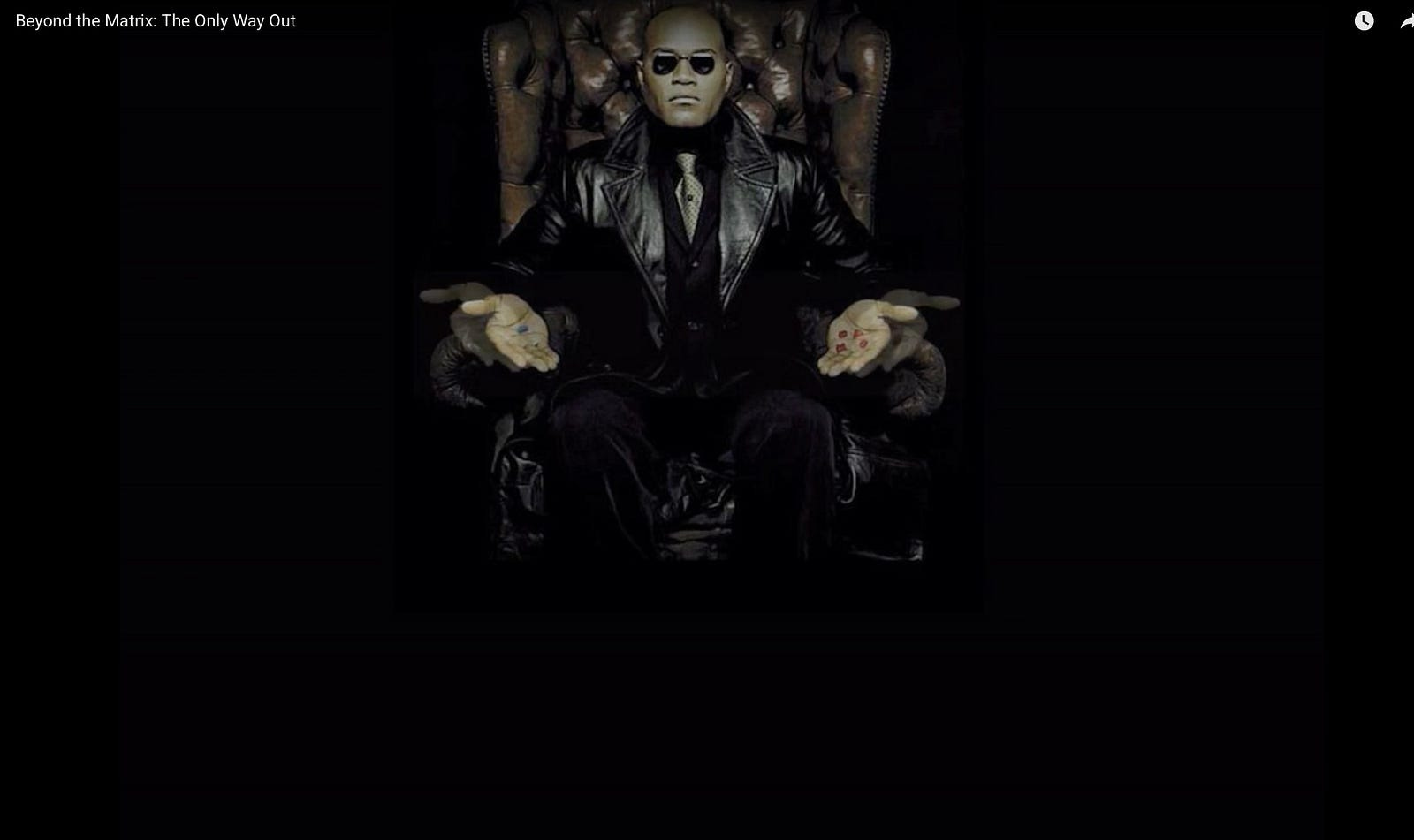
I just heard that, a few weeks ago, Dawkins admitted that there’s a possibility that consciousness might exist outside the brain. So far, he hasn’t provided any basis for this, and heck, maybe he’s wrong.
What do you think? Is there a scientific basis for what Dawkins said, or is he still stuck with the blue pill?
(by the way, someone complained I didn’t give the reference for Dawkins - right!)
DOES SCIENCE PROVIDE EVIDENCE FOR ANY PHILOSOPHIC VIEW?
The understanding I developed when I was trained in scientific research was this: the nature of empirical research is such that it provides no evidence for any metaphysical view. You can be a scientist and a materialist, dualist, idealist, panpsychist, pantheist, monotheist, panentheist, non dualist, Taylor Swiftian, Jonathan Swiftian, Tom Swiftian, Tom Lehrerian, whatever you like!
**********************************************************
The greatness of modern quantitative science is that it is a method, not a philosophy, and — whether it’s the physical (physics, chemistry, astronomy, etc), life (zoology, botany, all branches of evolutionary biology, etc), or mind (neuroscience and psychology in all their variations) sciences, they provide structural/functional knowledge of quantitative relations based on sensory experience of the kind primarily found in our waking state.
This particular kind of knowledge is neutral because it holds no matter what metaphysical view you have.
Here is a simple thought experiment to illustrate (not “prove”) this. (Remember the “rules” for a thought experiment — anything goes. When Einstein described the thought experiment he used as part of the development of the theory of relativity, it was irrelevant that it is impossible to “ride” a beam of light)
UNDERSTANDING WHY SCIENCE DOES NOT PROVIDE EMPIRICAL EVIDENCE FOR OR AGAINST ANY METAPHYSICAL VIEW
Imagine you have been in a dream for the past 20 years. The dream universe you live in is a perfect replica of the waking state universe explored by scientists for the past several centuries. You have a genius level mastery of all science and mathematics.
Like Neo in the Matrix, you start to realize you may be dreaming but you’re not sure. So you start to reflect on what kind of experiment you might perform to determine whether or not you’re dreaming. As you develop your ideas for the research you’re about to conduct, you examine your universe carefully, and you try to imagine how your experiment will help you find evidence regarding the dream vs waking nature of the universe you find yourself inhabiting.
What experiment do you eventually conduct?
*****
TL:DR: You won’t succeed in finding any scientific experiment to help you, but just reading this witout attempting the thought experiment is statement is like taking the blue pill.
If you really are daring enough to take the red pill, try really hard to answer the question in the thought experiment.
Look around at what you see and hear…
notice the quality of your physical sensations…
look carefully at the kinds of stories your mind is telling you.
See what happens to your question of whether or not this is a dream state or waking state as you slowly realize you can’t figure out any experiment can help you one iota.
Honestly, what would change for you if you couldn’t tell the difference between the waking universe and the dream universe?
***********
If you’re not sure how to examine your experience in relation to the thought experiment above, here’s a simple way to think about it:
You’ve most likely heard about mindfulness.
Conventional mindfulness is about developing the ability to bring a gentle, calm, compassionate, nonjudgmental quality of attention to all the movements of our nature. In contrast, what has been called
Effortless mindfulness is the practice of turning the attention inward to become aware of the silent, calm, open-hearted Consciousness that is always present underlying those surface movements.
In other words, in spite of the sometimes superficial quality of the popular mindfulness movement, it is ultimately about learning to become conscious of our movements in the light of a deeper Consciousness within.
Child and adolescent psychiatrist Daniel Siegel has come up with a simple, easily accessible metaphor to teach this deeper method of effortless mindfulness, which he refers to as the “Wheel of Awareness”: Over 5 million children in schools around the planet have learned this. Siegel has used it to cure severe depression, anxiety, trauma and even bipolar disorder (which mental health workers believe can’t be healed without medication).
Arrayed out on the rim of the wheel are all the things we’re aware of. At the center or “hub” of the wheel is the Awareness or Consciousness which takes in all that we experience.
With a conventional mindfulness practice, we can learn to bring a quality of kind, non-judgmental, calm equanimity to the way we attend to the things on “the rim of the wheel.” But what Siegel is teaching is the essence of effortless mindfulness — remembering to shift attention back to the “hub” again and again and again — and to view everything on the rim from that inner stance.
–
In addition to the millions of children learning this in school, Dan Siegel has taught this form of effortless mindfulness practice in person to over 50,000 people (many of whom have never engaged in any form of meditative practice). They have described their experience of shifting to the hub using words such as “complete peace,” “joy,” “love,” a sense of emptiness and fullness at once,” “as if time has disappeared,” “as wide as the sky,” “vast,” “peaceful,” serene,” “Infinite.”Some have said it was the first time they felt “at home in the universe,”v others said they understood God for the first time.
If you’re interested in exploring effortless mindfulness in community with others, please stop by: https://www.remembertobe.life/community (if you aren’t sure but want to hear more about it, please click “Subscribe” on the upper right hand corner of that page)
The title of your post mentioning Dawkins is pure clickbait. It does not even provide a source for his supposed change of mind.
“Imagine you have been in a dream for the past 20 years. The dream universe you live in is a perfect replica of the waking state universe explored by scientists for the past several centuries.”
This is where you go wrong, in the very first sentence. Of course, by assuming the dreamworld is a “perfect replica” of the waking world, there is no way we can tell them apart. But dream worlds are never a perfect replica. And they are created by our minds, which the real world isn’t (so that is your point?)
But usually we recognized we are dreaming, for example when we are able to fly, or walk through walls - things we can’t do in the real world. And when we wake up, we usually remember our dreams, and recognize we dream about things we have experienced in life, usually in a distorted way.
If your drift is that, since we can’t tell dream from reality in a dream, we might as well be in a dream when awake, what is the point of this experiment?